
In reflective mode, ambient light passes through every display layer twice: once on the way in and again on the way out. Each added layer, whether a touch sensor or a cover lens, therefore reduces contrast more than it would on a backlit display. For commercial and industrial equipment that needs a transflective touch screen or a reflective LCD touch panel, stack design decides whether the screen stays readable outdoors.
People Also Ask
Does a touch panel reduce sunlight readability on a transflective display?
It can. In an unbonded setup, a touch panel adds reflective interfaces. An optical bonding transflective display removes those gaps and restores most of the contrast.
Is antiglare or antireflective better for a reflective LCD touch panel?
AR preserves sharpness and cuts mirror reflections; AG diffuses harsh glare with slight softening. Many designs combine both.
Can you add treatments without replacing the cover glass?
Yes. E3 Displays can apply AR, AG, and AF/AS through film lamination or coated glass.
Why Reflective Modes Are More Sensitive to Added Layers
A backlit display pushes its own light outward once. A reflective display relies on ambient light that must travel down through the stack, reflect, and travel back up. Any absorption or haze in a layer is applied on both trips. Meanwhile, surface reflections bounce ambient light straight back to the viewer without carrying the image, washing out contrast. A reflective LCD touch panel has no backlight surplus to overpower that loss. Read our complete guide to choosing a reflective LCD monitor for every light condition.
Where Reflections Occur in an Air Gapped Touch Stack
Reflections occur wherever the refractive index changes. In an air-gapped stack, that means the cover glass front surface, the cover glass rear surface, both sides of the touch sensor, and the LCD front polarizer facing the gap. Each glass-to-air interface reflects roughly 4% of incoming light. Stacked together, several of them can bury a reflective image in glare.
How Touch Sensor Construction Influences Light Loss
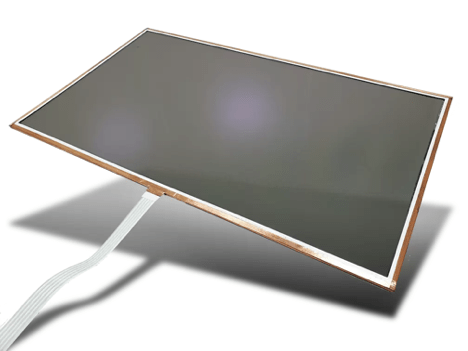
Touch sensors add conductive layers and substrates, so their construction affects transmission and haze. E3 Displays offers 13 different touch screen technologies, including projected capacitive (PCAP) and resistive touch, through its Touch Panels line. PCAP is the mainstream choice, using a capacitive grid under a glass overlay that supports multi-touch, as described on the PCAP Touchscreens page. E3 Displays is touch IC supplier-neutral and works with all touch controller brands, so you can choose the sensor for the optical stack rather than a single controller vendor. For a transflective touchscreen, the lowest-loss sensor that meets the touch requirement is usually the right choice.
How Optical Bonding Reduces Internal Reflections
Optical bonding fills the air gaps with an optical-grade adhesive whose refractive index matches the glass and LCD. The internal glass-to-air interfaces disappear, leaving the front surface as the main reflection to manage. E3 Displays offers LOCA, OCA, and combined bonding methods and bonds exclusively with E3 Materials urethane acrylate adhesives developed to be application- and display-specific. An optical bonding transflective display also gains durability because the bonded stack resists impact, vibration, and condensation inside the gap. Bonded or air-gapped is one of the first transflective display specification questions to settle.
Choosing Cover Glass Treatments for Ambient Light Viewing
Once internal reflections are bonded out, the cover glass surface becomes the priority.
- Antireflective (AR): Cuts specular reflection so operators do not see their own reflection or bright objects mirrored on the screen. It preserves image sharpness, which suits fine text and detailed graphics.
- Antiglare (AG): Scatters reflected light to diffuse the hard glare of the sun or overhead fixtures. The trade-off is a slight loss of sharpness, because the textured surface also scatters some image light.
- Antifingerprint (AF/AS): Reduces oil retention on the cover lens, keeping a transflective touch screen clear of smudges that scatter light.
AR and AG are often combined. Heavier AG suits direct overhead glare; AR alone suits applications where sharpness matters most.
Film Lamination as an Alternative to Coated Glass
E3 Displays can apply AR, AG, and AF/AS properties either through coated glass or through film lamination to the display. Film lamination can be a practical route when the cover glass is already specified or when treatments need to be added to an existing design. Contrast enhancement films laminated to the display further suppress reflected light.
Balancing Durability, Touch Accuracy, and Readability
Thicker cover glass improves impact resistance but adds distance between the finger and the sensor and more material for light to cross twice. Readability treatments must also withstand cleaning and repeated touch. For a reflective LCD touch panel in industrial use, settle the cover thickness, touch technology, and treatment together. E3 Displays can tune PCAP solutions for demanding use, including environments where surface water can trigger false touches. The panel itself also shapes the stack, so read our comparison of memory LCD vs. transflective TFT displays before locking in the cover design.
Evaluating the Finished Stack Under Real Lighting
Judge the complete stack, not individual layers. View prototypes in direct sun, under overhead fixtures, at an angle, and in low light with the backlight on. Check readability with the touch panel active, after cleaning, and with typical fingerprints present. A stack that looks good on the bench can fail at a sunlit workstation.
Conclusion
In reflective mode, every layer counts twice. A readable transflective touch screen or reflective LCD touch panel comes from a low-loss touch sensor, bonded interfaces, and the right front surface treatment, verified under real lighting. Explore E3 Displays Touch Panels, PCAP Touchscreens and Optical Bonding, or contact us today!