

Digital Chart Tables, Wide Temperature Ranges, Durability
Rugged military displays are LCD and touchscreen systems engineered to keep working in extreme heat, cold, sand, dust, water, shock and vibration. E3 Displays, an ITAR-registered display manufacturer in Phoenix, Arizona, designs custom military displays and touchscreens with optical bonding, sunlight readability, NVIS compatibility and thermal management, built to standards such as MIL-STD-810.
The military operates in some of the harshest environments on earth, and it needs rugged military displays that are zero-fail and long-lasting. E3 military display solutions give military leaders peace of mind during the most mission-critical situations. Our displays for rugged military laptops withstand dust, heat, water and heavy glove use. The custom military LCD display solutions we provide include custom touch panel integration, high-efficiency brightness enhancements, wide temperature and humidity range solutions, active and passive thermal management, embedded computer integration and much more. Missions today require execution, and we’re here to help you complete yours.
E3’s military experience is proven at scale. In 2008, E3 was awarded a multi-million-dollar contract to supply 50,000 integrated, optically bonded displays to a U.S. military supplier. That program set the standard for the reliability we deliver on every defense project today.
What Makes a Military Display Rugged?
A rugged military display is built so that heat, cold, moisture, impact and vibration don’t affect readability or touch accuracy. It combines a high-performance LCD, a protective cover, optical bonding, sealing and thermal management in one engineered assembly.
Commercial screens are designed for offices and living rooms. Military rugged displays go into tanks, armored vehicles, ships, field computers and command centers, where a failed screen can stall a mission. That’s why E3 engineers every unit as a complete system, from the LCD cell to the bezel, gaskets and interface cable. Each one builds on the engineering behind E3’s rugged industrial displays L3, then adds the requirements that defense programs demand.
Rugged Military Display vs. Commercial Display
| Factor | Commercial display | E3 rugged military display |
|---|---|---|
| Construction | Air gap between LCD and cover glass | Optical bonding fills the air gap for impact and moisture resistance |
| Readability | Washes out in direct sunlight | Sunlight readable, with brightness enhancement up to 2,500 nits |
| Night operations | Emits infrared that interferes with night vision goggles | NVIS compatible options designed to meet MIL-STD-3009 |
| Touch input | Bare finger touch only; fails touches from water | P-CAP tuned for heavy glove use and liquid splash false touch resistance |
| Temperature | Narrow operating range | Wide temperature LCD options (as wide as -40°C to 85°C) plus heater films |
| Shock and vibration | Not designed for it | Component potting and vibration mitigation |
| EMI | Unshielded | EMI/RFI reduction with conductive gaskets and shielding |
| Lifecycle | Short product cycles | Long availability without change, plus lifecycle support |
Primary Applications of Military Displays
We create modules that have the ability to be installed into various Military systems including but not limited to…
- Land Vehicle Display Systems
- Computers and Servers
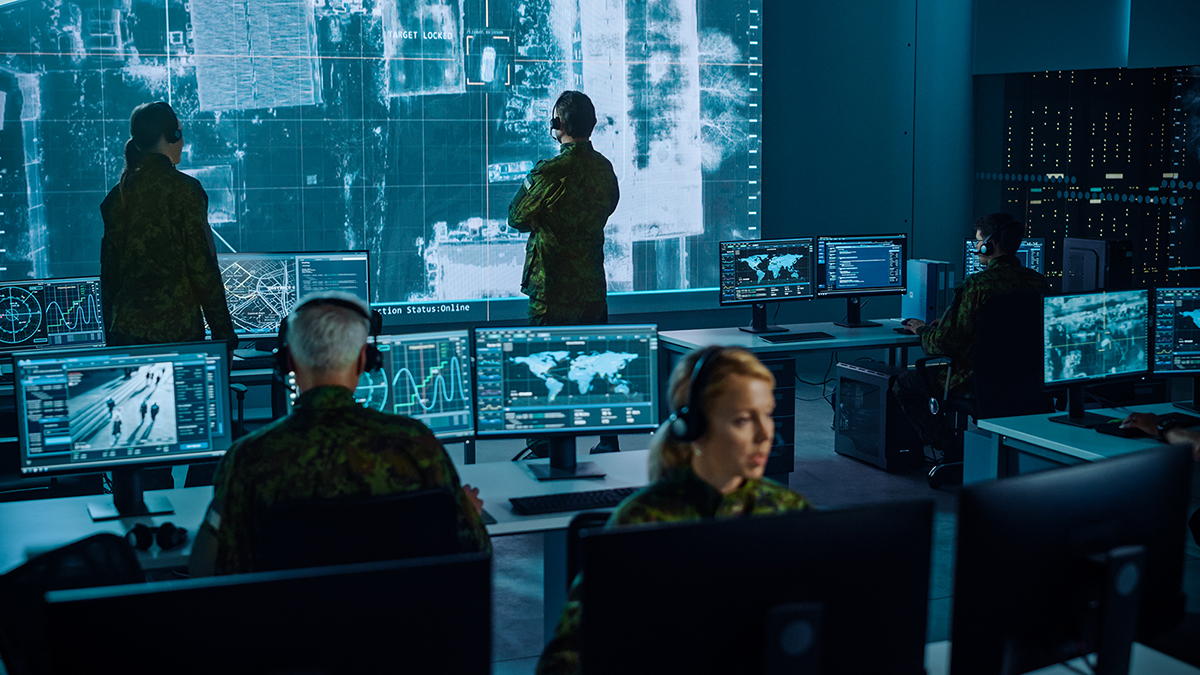
- “Tactical Tables” (Digital Chart Tables)
- Maintenance Systems
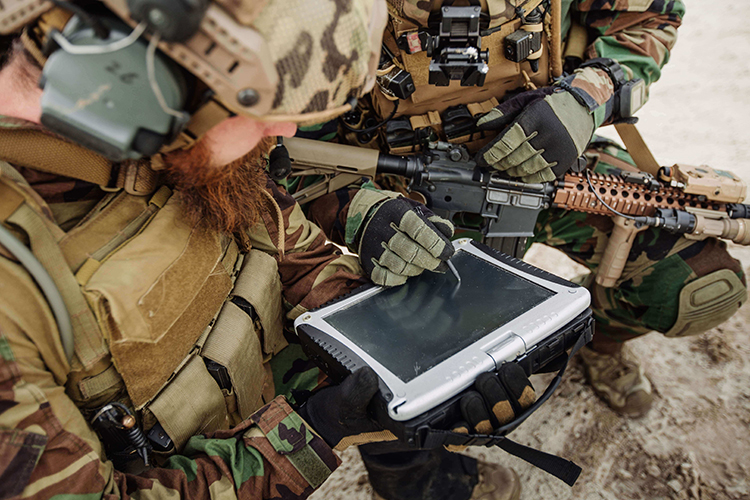
Each platform faces different threats. Vehicle displays in tanks, Humvees and armored carriers take constant shock, vibration and power fluctuations. Digital chart tables need large, precise touch surfaces for mission planning, which is where large format touchscreen displays come in. Handheld field devices need to be light and power-efficient, and OLED displays suit them well because they need no backlight. For airborne platforms, E3 also engineers dedicated avionics displays.
Military Displays: High-Performance Features for Harsh Military Environments
Optical and Readability Features
- Optical bonding
- Wide range dimming solutions
- High attenuation
- High transmission
- Active and passive thermal management
Features of Rugged Military Displays
- Optical enhancements and filter laminations
- Wide temperature and humidity range solutions
- Component potting and vibration mitigation
- Sunlight readability
- Dual-mode operation
These features work together so operators can read the screen in any light. Optical bonding attaches the cover glass to the LCD with E3’s proprietary UV-cured adhesive. This cuts internal reflections, blocks condensation and strengthens the display against drops and jolts. High transmission keeps the image bright, while high attenuation and filter laminations control unwanted light. Wide-range dimming lets the same display go from full daylight brightness down to the very low levels needed at night.
Dual-mode operation is critical for night missions. E3’s NVIS-compatible displays use NVIS filters to limit infrared emission so they don’t interfere with night vision goggles, and they still perform normally in daylight. All E3 NVIS solutions are designed to meet MIL-STD-3009.
In extreme cold, E3 optically bonds transparent heater films to the display. A built-in sensor switches the heater on at a preset temperature, which protects the LCD and conserves power. In extreme heat, airflow enhancements and optical-material heat transfer move heat away from the panel without noisy internal fans. Component potting secures electronics against the constant shock and vibration of ground vehicles and shipboard systems.
Military Touchscreen Solutions That Work With Gloves, Rain and Grime
A military touchscreen must register precise input through heavy gloves and ignore false touches from rain, splashes and debris. E3 builds military touchscreens on PCAP (projected capacitive) technology with tuned firmware and custom sensor layouts to meet these demands.
Standard touchscreens can mistake a water droplet for a finger. That’s unacceptable on a vehicle display during a rainstorm. E3 works directly with touch panel manufacturers to tune controller firmware, size the ITO traces and spacing, and optically bond the sensor to the LCD for accurate, parallax-free input. To see how this works in harsh field conditions, read about the innovation behind E3 rugged touchscreens.
Military LCD Display Capabilities
E3’s military rugged LCD display systems are built from these core capabilities:
- High-performance specified LCDs with good to very high brightness and contrast levels, wide viewing cones, long backlight life and wide temperature ranges
- Custom PCAP touch panels with support for sunlight-readable displays, heavy glove use and liquid splash false-touch resistance
- EMI/RFI reduction solutions
- Optical bonding of LCDs, touch panels and lenses
- Specialty chassis, enclosures and computing modules, delivered as single-part-number integrated solutions
- Reliability and support focused on high quality and the longest availability without change
MIL-STD Testing and Quality Standards
E3 designs military displays to recognized standards such as MIL-STD-810 L15 and RTCA DO-160, and its NVIS solutions are designed to meet MIL-STD-3009. Testing is done both in-house and by third parties:
- In-house: temperature and humidity cycling, thermal shock, vacuum and high-pressure conditions, and optical assessments
- Third-party: shock, vibration and solar radiation testing at the assembly level
- Manufacturing: a Class 10K cleanroom that supports military production, ISO 9001:2015 quality systems, and factory testing and final inspection on every unit
- Materials: E3 tested silicone adhesives and found them inadequate for harsh military environments, so it doesn’t offer them. It bonds with its own proprietary adhesive instead.
Why Choose E3 Displays for Rugged Military Displays?
In the field, equipment failure isn’t an option. E3 Displays understands the importance of quality, reliability and precise execution. Our experienced team will help with the design, customization and manufacturing of your military display. We are ITAR Registered and our knowledgeable staff has decades of experience in helping you produce a display solution that will fit the toughest requirements. We are knowledgeable with MIL-SPEC standards and all of our displays are tested in the harshest environments ensuring it will last the entire life of the display. Rugged Military Display suppliers depend on E3 Displays experience and technology to produce some of today’s highest profile military approved display solutions. We have a highly educated team that combines innovation and technology to produce the most effective displays for the naval and defense community. It is key for any supplier to embrace the challenges that come along with creating a display with the highest standards in a market where security means everything. We offer military grade display and touch sensor based solutions that are tailored for the highest quality and latest technology.
- Proven at volume: 50,000 optically bonded displays supplied for a U.S. military program
- Proprietary bonding: Adhesive formulated in-house by E3 Materials LLC
- Turnkey delivery: Full bill-of-materials sourcing, design collaboration and single-part-number assemblies
- Lifecycle support: From concept to end of life, including transitions when a component becomes obsolete
- Scalable production: Prototypes and small batches get the same attention as full-rate production
ITAR Certification
How E3 Builds Your Custom Military Display
Identify: Define the platform, mission environment, MIL-STD requirements and interface needs with an E3 engineer.
Design: Create CAD drawings, specifications and a bill of materials.
Develop: Build prototypes and samples for validation and environmental testing.
Enhance: Add optical bonding, PCAP touch, NVIS filters, heaters, EMI shielding and enclosures.
Manufacture: Produce, test and inspect every unit, from prototype quantities to full-rate production.
Case Study: Military
Partner With an ITAR-Registered Maker of Rugged Military Displays
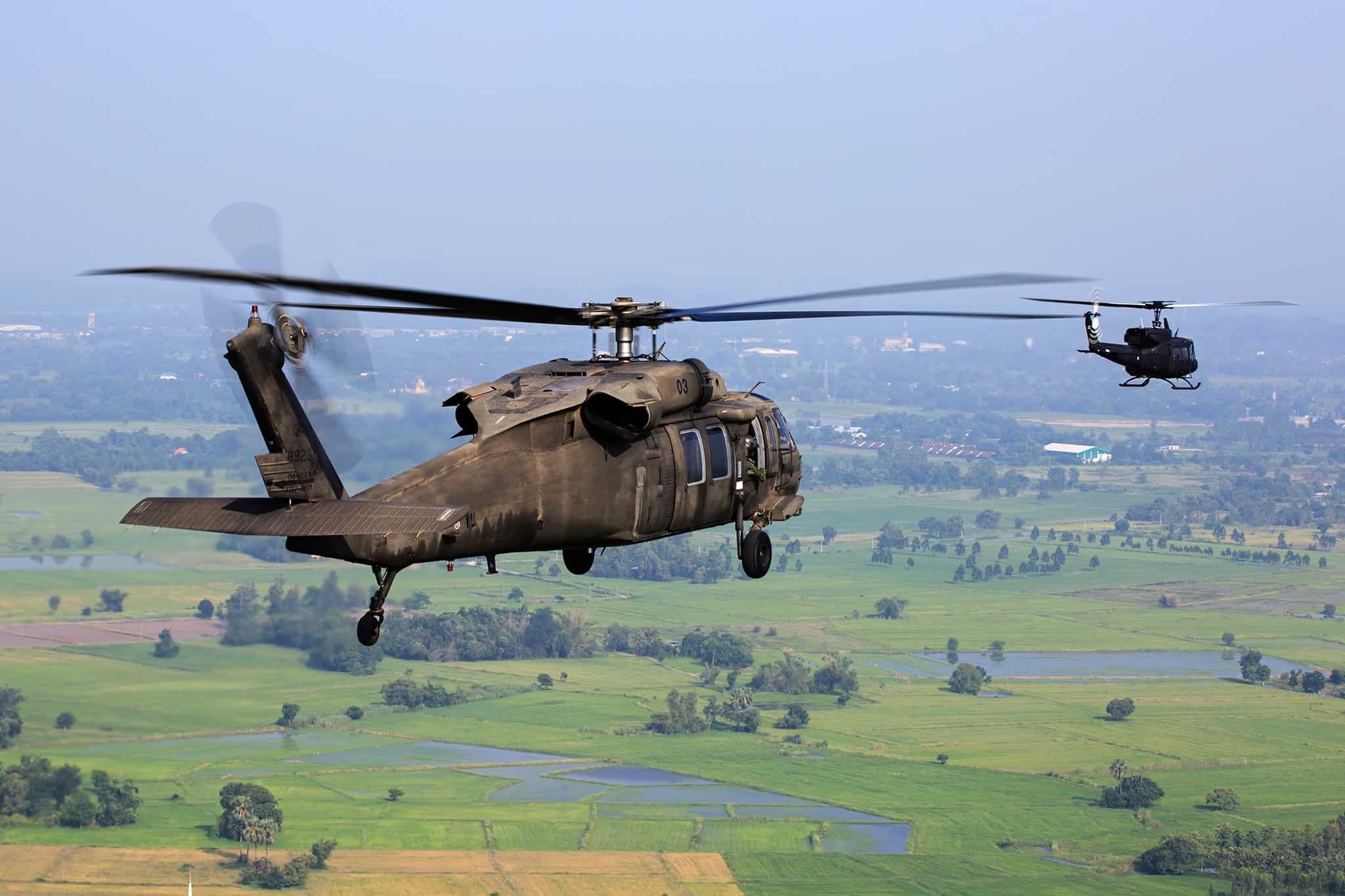
From armored vehicles to digital chart tables and shipboard systems, rugged military displays have to perform when everything else is working against them. E3 Displays combines proprietary optical bonding, glove- and rain-ready military touchscreens, NVIS compatibility, thermal management and MIL-STD-focused testing in custom solutions built for your platform. Whether you’re upgrading an existing display or developing a new military LCD display system, our engineers are ready to support your mission.