Transparent OLED panels are redefining how visual information integrates with physical environments. Unlike conventional panels that block light, these displays allow light to pass through while still delivering an active image. For commercial and industrial businesses, this creates new design opportunities in embedded systems, integrated system enclosures, and advanced interface panels.
This article examines the internal technology powering transparent OLED displays and why engineers increasingly evaluate them for specialized applications.
People Also Ask (PAA)
What makes a transparent OLED display different from a standard OLED display?
A transparent OLED display uses partially transparent electrodes and substrates, allowing light transmission through inactive areas while still emitting light at active pixels.
Are transparent OLED displays suitable for industrial environments?
They can be suitable when properly integrated with protective encapsulation and environmental controls. Application requirements must align with brightness and durability limits.
Why Transparent OLED Is Gaining Attention
Transparent OLED technology enables visual data to appear layered over transparent surfaces. When inactive, the panel remains partially transparent. When active, it emits light from organic layers, eliminating the need for a traditional backlight.
Industries are exploring transparent OLED displays because they:
- Reduce mechanical layering in display assemblies
- Enable compact and lightweight system designs
- Support modern industrial interface concepts
- Maintain visual clarity when the display is not active
This capability makes the technology particularly relevant in advanced commercial equipment and high-visibility industrial installations.
What Is a Transparent OLED Display?
A transparent OLED display is a self-emissive panel that generates light directly from organic semiconductor materials. Unlike LCD technology, it does not rely on a backlight module. Instead, each pixel emits its own light when electrically stimulated.
In a transparent OLED configuration, portions of the panel remain optically clear. This allows background objects to remain visible through the display when pixels are inactive.
Key characteristics include:
- Self-emissive pixel structure
- High contrast ratio
- Thin panel construction
- Partial light transmission through the display substrate
Because no backlight blocks transmission, transparent OLED displays achieve a distinctive combination of display output and transparency.
Core Layer Structure of Transparent OLED Technology
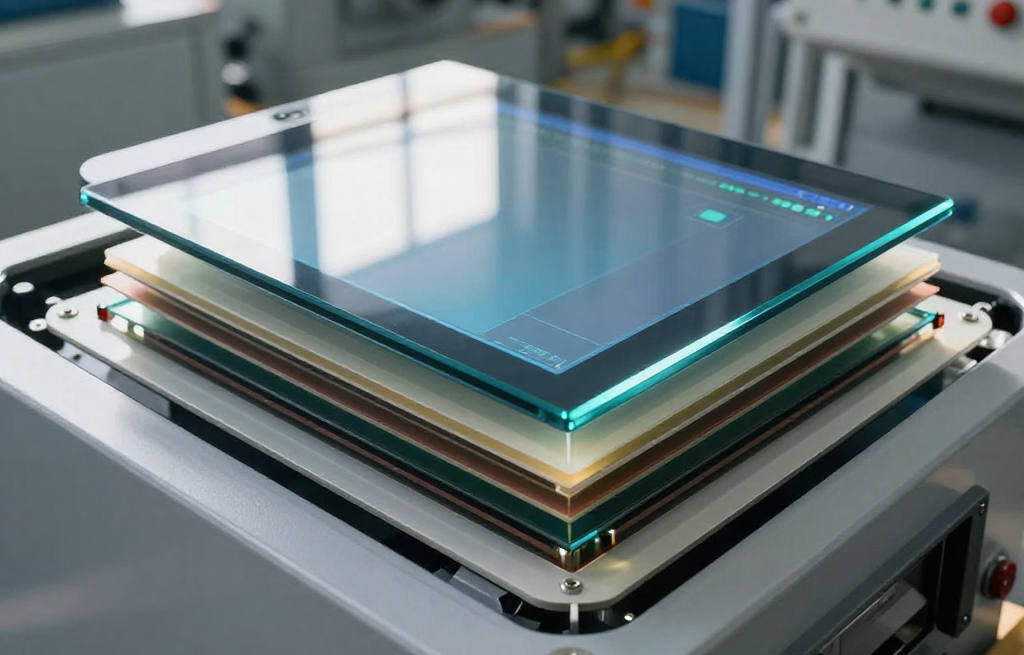
Transparent OLED panels rely on a precisely engineered stack of functional layers. These layers are deposited onto a transparent substrate, typically glass.
A simplified layer structure includes:
- Transparent substrate
- Anode layer (often indium tin oxide)
- Organic emissive layers
- Cathode layer (partially transparent or ultra-thin metal)
- Encapsulation layer for environmental protection
The organic layers sit between the anode and cathode. Applying voltage recombines electrons and holes in the emissive layer, producing light.
To maintain transparency, electrode materials and structural layers must allow light to pass through. This requires careful material selection and precise thickness control during fabrication.
How Light Emission Works in Transparent OLED
Light emission in transparent OLED displays occurs at the pixel level. When current flows through the device:
- The anode injects positive charge carriers (holes).
- The cathode injects electrons.
- Charges recombine in the emissive layer.
- Energy release generates visible light.
Because each pixel emits light independently, the display does not require a backlight. This reduces internal reflections and supports high contrast.
Transparency is preserved because non-emitting areas remain partially clear. However, total transparency depends on panel design and electrode configuration.
Key Technical Challenges
Transparent OLED technology introduces several technical constraints that engineers must evaluate.
Common challenges include:
- Lower peak brightness compared to conventional OLED panels
- Reduced transparency when pixel density increases
- Environmental sensitivity of organic materials
- Encapsulation requirements to protect against moisture and oxygen
Balancing transparency and luminance is a core design trade-off. Increasing transparency often limits overall brightness. Increasing brightness may reduce optical clarity.
Thermal management and long-term material stability also require careful system integration planning.
Common Applications of Transparent OLED
Transparent OLED displays serve specialized use cases where visibility through the display surface remains important.
Commercial and industrial applications include:
- Industrial equipment panels with overlay data
- Smart glass integration in controlled facilities
- Interactive enclosures and embedded display systems
- Advanced retail and exhibition systems
- Transportation and architectural interface concepts
In these environments, the display must deliver visual output without fully blocking the underlying structure.
Future Developments in Transparent OLED Technology
Research continues to improve transparent OLED efficiency and lifespan. Material advancements aim to:
- Increase luminous efficiency
- Enhance moisture resistance
- Improve encapsulation durability
- Expand panel size options
Manufacturing refinement is also reducing production variability. As process control improves, transparent OLED displays are expected to see broader commercial and industrial deployment.
Organizations evaluating custom OLED display integration can contact E3 Displays to review available options and support informed decision-making.